
Ocean Grove, NJ. 1923. Photographer unknown. Submitted by Eileen Goldfinger © 2015.
KATHY BRIER From vol 1 of the soundtrack from Boardwalk Empire. Orchestra by Vince Giordano and the Nighthawks, Grammy winner for this amazing HBO series.
Posted in Ocean Grove history, Photographic Gallery: Ocean Grove, tagged Ocean Grove historic photograph on May 10, 2022| 1 Comment »
Ocean Grove, NJ. 1923. Photographer unknown. Submitted by Eileen Goldfinger © 2015.
KATHY BRIER From vol 1 of the soundtrack from Boardwalk Empire. Orchestra by Vince Giordano and the Nighthawks, Grammy winner for this amazing HBO series.
Posted in Blogfinger News, Ocean Grove history, Ocean Grove history by Blogfinger, tagged Ocean Grove history, Ocean Grove history timeline, Timeline on April 11, 2022| 2 Comments »

This photograph (with permission) is the first in Ted Bell’s ” Images of America: Ocean Grove.” CLICK TO ENLARGE
BLOGFINGER RE-RUN FROM 2010. It’s important that more people other than tourists learn OG history. This timeline gives some perspective for new Grovers and others who ought to educate themselves to this sequence of events. Thus we periodically re-post this timeline.
By Paul Goldfinger, MD, Editor @Blogfinger.net.
Ocean Grove’s history is a fascinating saga about how a Methodist summer community founded in 1869 eventually evolved into a historic and diverse year-round tourist town while preserving its religious and architectural characteristics.
Sure it’s about the Camp Meeting Association (CMA), the Great Auditorium, the tents, and the famous religious figures who took center stage since the founding, but there is so much more to tell, particularly about the town’s secular history including: its governance; the multiple attempts to secede from Neptune; the successful but temporary creation of an independent secular Borough of Ocean Grove in 1920; opening of the gates in 1979; loss of governance by the CMA in 1980; the decline of the “blue laws”; the extraordinary successes of the Ocean Grove Homeowner’s Association as they transform OG from shabbiness to renaissance by the 1990’s; the remarkable demographic changes of the 1990’s including the growth of the gay community, the amazing musical heritage, the fights over taxes, and there is so much more.
The Historical Society of Ocean Grove has offered wonderful exhibits about such topics as the women’s suffrage movement and the African-American “history trail” here, and we at Blogfinger have run two pieces about John Phillip Sousa in Ocean Grove as well as the account of Paul Robeson’s 1925 concert in the Great Auditorium.
We plan to continue our series of articles on some of the less well known accounts in Ocean Grove’s history, especially focusing on secular events. We will begin the process of digging into Ocean Grove’s fascinating past with a time-line. It’s important for Grovers to know this history. You may be surprised by some of the items below:
1869: Ocean Grove is founded by the Rev. William Osborne and his colleagues. They form the Ocean Grove Camp Meeting Association of the Methodist Episcopal Church (CMA) and begin purchasing land. The town is part of Ocean Township. The CMA’s goal is to provide and maintain a Christian seaside resort.
1870: The New Jersey Legislature grants a charter to CMA which allows them to govern in Ocean Grove. They can make ordinances, establish a police department and a court of law, and administer all infrastructure and services including schools, sanitation and library.
The town is designed “from scratch,” becoming one of the first planned communities in the US. The first lots are “sold” (i.e. leased) from the CMA which retains ownership of all the land. The first cottage is built in 1870.
1872: Over 300 cottages have been built.
1875: Rev Adam Wallace founds the Ocean Grove Record, the town’s first newspaper. Rev. E. H. Stokes, the first CMA President says, regarding the gate closure on Sunday, that “there is no human probability that these rules will ever be revoked.” The first train from New York arrives in OG. People begin to stay year round.
1879: The NJ Legislature creates Neptune Township by carving it out of Ocean Township and incorporates Ocean Grove’s boundaries as part of Neptune. Ocean Grove CMA and lot/home owners pay taxes to Neptune. Leaseholders (“lessees”) must continue to pay “ground rent” to the CMA.
The CMA refuses all services from Neptune and continues to function as the “governing authority,” maintaining rigid control in OG. Physical isolation within its boundaries, “blue laws,” land ownership, and a homogeneous population of Methodists contribute to the sustained CMA rule. Ocean Grove is, in practice, a theocracy. But that will become a problem for them over 100 years later.
1897: The first mention of tax discontentment appears as CMA President Bishop Fitzgerald speaks publicly about Neptune’s tax bill and says, “Of the discrimination against us in the matter of taxation does not as yet seem to admit of remedy.”
1898: Ocean Grove’s “lessees,” who pay property taxes to Neptune Township, want the CMA to pay the land taxes to Neptune. A suit is brought by the homeowners, but in 1900 the NJ Supreme Court sides with the CMA.
1912: Ocean Grove’s citizens want to participate in the town’s governance, so they elect a Board of Representative Lessees to join with the CMA in managing the town’s affairs. There was unrest, with many citizens disliking this peculiar arrangement and wanting Ocean Grove to be a regular town with an elected secular government.
1915: the Ocean Grove Taxpayers and Protective League is formed.
1918: CMA has financial problems and asks Neptune to take over police, garbage and sanitation functions. Neptune refuses.
1920. The Lessee Board is dissolved, and the Civic Betterment League is formed. Its goal is the creation of an independent Ocean Grove Borough. The CMA supports the idea, and the NJ Legislature passes an Ocean Grove Borough bill which creates an incorporated borough, apart from Neptune. Governor Edwards signs it into law, a referendum in town receives wide support, and local elections are held.
The new Borough of Ocean Grove operates for one year, but they retain the CMA “blue laws”. Opponents in town want things the old way and they form the “Lessees Association” They sue in State Supreme Court.
1921: The NJ Court of Errors and Appeals finds the Borough bill to be unconstitutional, because the Borough has allowed religious ordinances to stand. The Borough bill might have been upheld if the “blue laws” were discarded, but the CMA and its supporters refuse. The Borough is dissolved, and governance goes back to Neptune and the CMA. This was not the first attempt to gain secular control of OG, but this one came the closest.
1923: A bill to make Ocean Grove a separate tax district with its own tax rates gets “lost in the legislature.”
1924: A big battle ensues as Neptune tries to substantially increase the CMA’s taxes, including high taxes on the beach, Auditorium, streets, sewers, etc. CMA wins in 1925 at the NJ Tax Board, and most of their holdings are not taxed.
1925-1960: The town is a popular summer resort and is known internationally. Huge crowds visit along with US Presidents and many celebrities. As for the ongoing arguments in Ocean Grove, the historian Gibbon says, in 1939, “Many times residents and land lessees of the town have voiced their objection to the local rules, to the tax situation or to the form of government, especially from 1900-1925, and there have been many court fights.”
For the most part, things stay the same.
1960-1980: Ocean Grove declines, along with much of the Jersey shore. (See below)
1975: A group of dedicated citizens led by Mr. Ted Bell and his colleagues obtain approval for OG’s designation as a State and National historic district. It is a complicated process. Formation of Board of Architectural Review (BAR) happens in 1984. (Later re-named the Historic Preservation Commission—HPC.)
1975: A newspaper service sues over Sunday’s gate closures, which had been permitted by town ordinance. The NJ Supreme Court strikes down the ordinance on grounds that it violates the first amendment to the Constitution (freedom of the press). The gates are opened for the news service only, but the CMA is allowed to continue its theocratic governance of Ocean Grove and the enforcement of other “blue laws”. Many people in Ocean Grove view the gates’ opening as an unhappy event.
1977: A lawsuit stemming from a drunk-driving conviction challenges the authority of Ocean Grove’s municipal court. The NJ Supreme Court widens the scope of the case and decides in June, 1979 that CMA governance in Ocean Grove is in violation of the Constitutional separation of church and state. Appeals are filed. This marks the beginning of the end for CMA governance in OG.
1980: The US Supreme Court would not hear the appeal, so governance of OG is transferred from the CMA to Neptune Township. Neptune eventually eliminates most of the blue laws. Only the Sunday morning beach closure and the ban on alcohol sales remain.
1980’s: By the 1980’s, the town is characterized by an overall “decrepitude,” including deterioration of buildings, declining tourism, crime, and a growing poor elderly population. (2) Deinstitutionalized mental patients are housed in empty old hotels and rooming houses in Ocean Grove. The town becomes a “psychiatric ghetto” (NY Times, October 1988), and, by the 1980’s, 10% of the town’s population are mental cases who are not receiving appropriate services and are sometimes abused by landlords. The prognosis for Ocean Grove is dire.
During this period, the Ocean Grove Homeowner’s Association (OGHOA) develops as a political and activist force that successfully begins the process of converting the town from decay to renaissance. (2f)
1990’s: OGHOA, led by Mr. Herb Herbst, Fran Paladino and others, fight for fair treatment in the allotment of the mentally ill around the state. The group’s political contacts and influence are considerable. The process is complex and difficult, but the numbers of “de-institutionalized” in OG drops considerably.
The group also saw to the closing of many substandard boarding and rooming houses. The HOA presents Neptune with a “master plan” to protect the historic nature of OG and to rezone for the promotion of single family houses. OGHOA promotes secular tourism while working with CMA to increase religious tourism. New people come into town to buy homes and invest in businesses.
1995:
The historic Neptune High School is saved from becoming low income housing by a group of Ocean Grove homeowners led by Mr. Herb Herbst and with the assistance of State Senator Joseph Palaia and others. (3, 4) The Jersey Shore Arts Center is owned and run today by a nonprofit tax exempt organization: The Ocean Grove Historic Preservation Society.
2000: Secular goals achieved as of 2000: increased property values, increased upgrading of houses, improved relations with Neptune, improved downtown with quaint shops, art galleries, cafes, etc., reduced crime, increased tourism, reduced de-institutionalized patients, demographic changes (increased gays, empty nesters, retirees, professionals, academics, young artists, and middle class families).
2005: House prices peak.
2007: New topics emerge: North End development, Ocean Pavilion dispute (gays vs. CMA), evolving demographics including more second home purchases, significant increases in property taxes, parking problems, Asbury Park development stalls, and home prices decline.
2009: Ocean Grove blog is founded (Blogfinger.net) by Paul Goldfinger, MD to help fill in the gap created when the OG newspaper closed. It offered a place to voice opinions about Ocean Grove’s many ongoing issues.
October 29, 2012. super-storm Sandy hits the Jersey Shore and destroys the Ocean Grove beachfront, part of the Great Auditorium roof, and floods the south side of town.
2009-2022: Blogfinger documents ongoing issues in town. Use the search engine on top right.
SAM AND DAVE:
ACKNOWLEDGEMENTS:
1. R. Gibbons, History of Ocean Grove: 1869-1939 (Ocean Grove Times, 1939)
2. K. Schmelzkopf, Landscape, ideology, and religion: a geography of Ocean Grove, New Jersey, Journal of Historical Geography, 28, 4 (2002) 589-608
3. Kevin Chambers, Herb Herbst, and Wayne T. Bell, personal communication,( 2008)
4. Archives, Asbury Park Press, (Feb 19, 1997.)
Posted in Blogfinger News, Ocean Grove history, tagged Ocean Grove history--lesson one, Realtors in the Grove on April 3, 2022| 1 Comment »
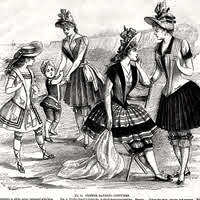
Swimwear from “Victorians’ Secrets.” *
By Paul Goldfinger, history editor @Blogfinger
In 1869, the Founding Fathers founded Ocean Grove in Larry’s Park (later, the name was changed to Founders’ Park.) Soon thereafter, many visitors came to this popular resort. Some people wanted to live here, but sleeping in tents began to wear thin, so a building boom began, and along with that came realtors in 1872.
They opened an office on Main Avenue and called it Century 19. Many of the realtors were young ladies who wore billowing dresses with hoops and crinolines that made them extra wide. It was fun watching 2 or 3 of them squeeze inside a tent. They drove their clients around in shiny buggies that said “20% down” on the back.
The sales pitch for selling houses here must have been a challenge because of all the limitations: no horses in town on Sunday, no alcoholic drinks, no tossing pie pans on Sunday, no carousing on Saturday night, and no hanky panky.
Well, that last one was quickly tossed out due to overwhelming opposition by the folks in the choir, especially the basses and the sopranos. Besides, Grovers did need something else to do on Sunday.
Another reason why there was no “blue law” for sex was that a baby was conceived in the tent colony, and that is where the term “Founding Father” was born.
One of the problems was that Rev. Stokes had organized a lot sale. People came from New York City and Philadelphia to buy land in this unique town. Then, somehow, it turned out that they had purchased a lease. “What the heck avenue?” they complained.
But even today, no one knows why their house is sitting on somebody else’s land. Luckily, lawyers followed the realtors into town and they made it all official.
It should be noted that you couldn’t go to Asbury Park for fun back then, because it was a sedate place having just been founded in 1871. The Asburians tried to emulate the example of Ocean Grove, but good luck with that idea.
Watch for our next installment of “OG Historical Snapshots” when we will tell the story of Jewish Grovers and how they introduced bagels with cream cheese to God’s Square Mile.
*One of the girls in the picture is April Cornell. She eventually opened a beautiful shop on Main Avenue in the Grove, but she was forced out by some creepy developer from New York. After that she opened in Spring Lake where the locals appreciate her despite her baggy “cover your butt” fashions.
And now that Stokes is gone we hear that some new women’s fashions will debut this summer in the Grove. This photo reveals an example of a California style miniskirt. Who says that miniskirts cannot get any minier?

This photo from Santa Barbara is by SBCFireinfo/twitter. Their crowds are almost as big as ours in Ocean Grove, sponsored by the Chamber of Commercials and the OGCMA. Will the CMA object when she shows up in the Grove for Bridgefest ?
And here is Dinah Washington, who knows what to do on Sunday:
Posted in Blogfinger Presents, Ocean Grove history, tagged The Quaker Inn at Ocean Grove on October 30, 2021| 2 Comments »

Current photo of the Quaker Inn. 2021. By Lee Morgan of OG. Note that there is a new owner.
Paul Goldfinger Editor. Blogfinger.net
It wasn’t long after the founding of Ocean Grove in 1869 that the town became famous as a tourist attraction, mostly because of its specialty—-religious tourism. Along with that fame came the railroad and the building of hotels and rooming houses.
It is said that the Quaker Inn, located at #39 Main Avenue at the corner with Central, was built in 1875.
In the History of Ocean Grove dated 1939, by Gibbons, there were 84 hotels listed. The Quaker Inn Hotel was still listed at #39 Main Avenue.
Rich Amole, Blogfinger staff, took an interest in the Inn after finding the 1943 postcard below. Rich is the author of a meticulously researched history of the Shawmont Hotel.
.

Paul:
The attachment is a 1943 linen post card of the Quaker Inn. This wonderful card advertises 40 rooms with running water and private bath availability. Complete with a restaurant and soda fountain and two four digit phone numbers; back then the Quaker still maintains it’s 136 years of history pleasing all who come to stay at the corner of Main & Central in Ocean Grove.
Rich Amole. Source: Ebay
Editor’s Note: It’s remarkable how this image from over 70 years ago looks like today’s Quaker Inn.
The image shown above appears in black and white in Ted Bell and Chris Flynn’s book Ocean Grove in Vintage Postcards. They also have a photo (below—with permission) of the restaurant and soda fountain which was a bright and cheerful place seen in the picture above from the outside as the row of windows running along Central Avenue.
Ted and Chris report that the Quaker Inn ads said, “The Perfect Location for a Grove Vacation.”

The caption for the above photo says, “Shown is a partial view of the restaurant and soda fountain at the Quaker Inn. The Quaker style is reflected in the stagecoach wall hangings.”
History/mystery 2021: Recently Ocean Grover Lee Morgan found a page from the Ocean Grove Times dated August 27, 1915. It contains an interesting ad for the Ocean Grove Hotel. That hotel was not mentioned in the 1939 hotel list, but you can see that the address is #39 Main Avenue.
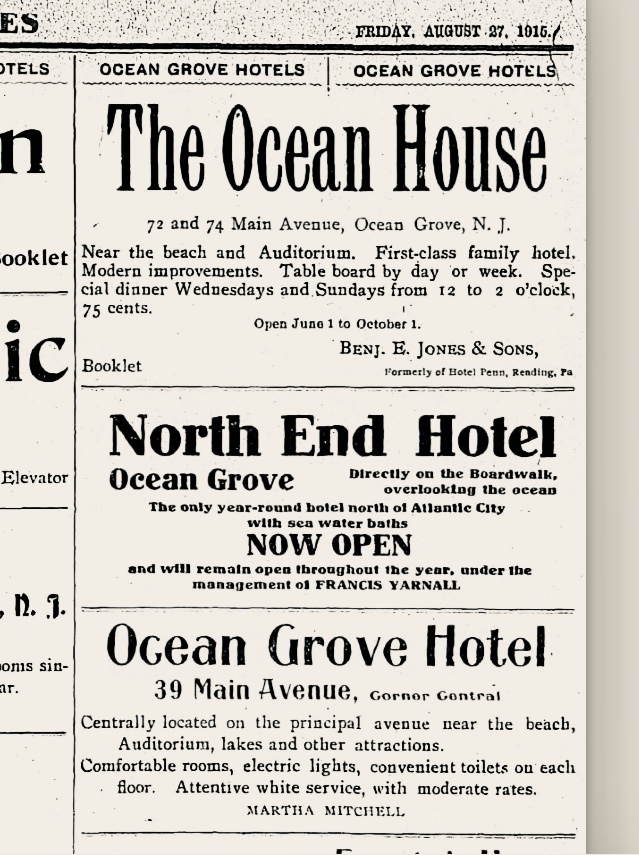

Photo courtesy of Lee Morgan. The Ocean Grove Hotel c 1915

Courtesy of Lee Morgan of Ocean Grove. A later photo. compare to above.
So, as Lee points out, The Quaker Inn is not the historic name for this hotel–It appears to have been the Ocean Grove Hotel. Thanks to Lee Morgan for pointing out this fact.
JULIE LONDON:
Posted in Blogfinger Presents, Ocean Grove history, Ocean Grove history by Rich Amole, tagged Strand movie theatre in Ocean Grove on August 24, 2021| 3 Comments »

The Strand was built in 1911 at the North End. Originally it was called Scenario. It was closed on Sundays. From Wayne T. Bell’s Images of America: Ocean Grove. (with permission)

July 1966. Submitted by Rich Amole

July 1966. Submitted by Rich Amole, Blogfinger historian and reporter.
Paul:
In the 1960’s, at the North End of Ocean Grove, the Strand Theatre was the place to go to the movies. The ads may have been simple hand outs that were distributed at the North End complex of entertainment and shops.
The depiction of the folks in line show that all are very well dressed— the ladies in high heels and skirts and the men in suits and hats. I’m guessing that seats could be had for under a dollar.
Now can someone bring me a nice buttered popcorn and cold Coca Cola. Forget that Tab stuff!
Rich Source: Ebay
ELVIS PRESLEY
Posted in Music: Jazz on Blogfinger, Ocean Grove history, Ocean Grove history by Rich Amole, Postcards From Ocean Grove, tagged postcards from Ocean Grove, Schooner off the Ocean Grove beach on August 7, 2021|

By Rich Amole, Blogfinger staff historian/researcher.
This is a postcard image of a tall sail schooner with a bit of a breeze hitting its sails off the Grove’s beach—- 108 years ago in 1906.
Not much on text back then— just a simple “Greetings from Ocean Grove” which still holds up today, not so much for that schooner………..
COLEMAN HAWKINS (tenor sax) From a jazz planet far, far away–contemplates the passage of time with “What a Difference a Day Makes”
Posted in Ocean Grove history, tagged What will happen to the fishing pier, What will happen to the OG fishing club on May 11, 2021| 18 Comments »

Source: “Ocean Grove in Vintage Postcards” by Bell and Flynn. With permission by Mr. W. Ted Bell of OG. Click image for full view
By Paul Goldfinger, MD. Editor @Blogfinger (Re-posted from May, 2013 on BF–Part 2 to follow)
The year is 1890. Ocean Grove is 21 years old, and the Rev. Elwood Stokes has a public health concern–how to deal with sewage so as to avoid infectious diseases in the campground. He writes about the subject in his annual reports, and that year he decides that their primitive sewer pipe system, where the mess is pumped into the ocean, needs to be improved. So he extends the pipeline out about 500 feet from shore and he builds a wooden pier opposite Embury Avenue to provide protection for the pipe.
A few years later, a better sewer system is devised, and the pier becomes a fishing pier with the Fishing Club receiving a multi-year lease and taking up 97 feet at the end. The 500 foot pier is destined to become a historic landmark in a historic Jersey Shore town.
Some years after that, when the North End is developed into a major recreational compound, a second pier, attached to the North End Hotel Pavilion, is built to attract strollers, fishermen and boats. Eventually it gets wiped out in a huge hurricane in 1938. During that viscious storm, the south end of Ocean Grove winds up underwater after 5 days of heavy rain. The Embury Avenue pier is also badly damaged.

Source: Ocean Grove in Vintage Postcards by Bell and Flynn.
Big storms knock out the pier and boardwalk on multiple occasions over the years including 1922, 1927, 1938, 1953, and a huge nor’easter in December 1992. The latter storm causes the Delaware River to back up and 4 counties along the shore to be clobbered. There are 90 mph winds in Atlantic City.
My old friend Nick Maat, a member of the Fishing Club, from 14 Heck Avenue, witnesses the pier clubhouse being carried away by a massive wave while he stands on Ocean Avenue soaking wet and jaw agape. The Asbury Park Press interviews him, and Nick gets his 15 minutes of fame. The pier is lost except for a small piece at the end where Ralph, the dummy fisherman, sits all by himself. (If he only had a brain.)
A book is written about the pier, Ralph, and the storm of 1992 by Carol Egner of Ocean Grove. It is called The True Story of Ralph–the Ocean Grove Fisherman.
In 1994, the pier is rebuilt, financed by a $144,000.00 small business loan obtained by the Fishing Club.
In 2000, a beach replenishment project causes the fishing pier to be landlocked after the water’s edge was moved eastward by 100 feet. The pier is 338 feet at that point, and a construction project adds another 144 feet to get the pier to its original 500 feet and over the water once again. The $150,000 project is financed by Monmouth County, the State, the OGCMA, the Fishing Club, and Neptune Township.

Landlocked fishing pier. c 2000. Asbury Park Press photo.
In August, 2011, Hurricane Irene causes damage to the pier. Some emergency repairs are done, but the pier is unsafe at its far end. The CMA fixes a few damaged parts of the boardwalk. FEMA declines to pay for repairs.
Then Sandy hits on October 29, 2012 and causes considerable destruction including the demolition of most of the pier. The clubhouse is swept out to sea in addition to all but a short section of the pier still attached to the boardwalk.
Finally, now, in 2013, a 165 foot piece of the pier will be repaired by the COGMA to allow the public to walk out a short distance—-over the sand. Engineers say that it is safe.
The OGCMA promises to rebuild the “non-fishing pier ” in its entirety, but that will come in the future. Mr. William Bailey of the CMA says that the small initial section will give people hope regarding the rest of the project. However, in a detailed press release dated April 30, the CMA did not mention the pier.
The OG Fishing Club has a long lease, but its future has been put on hold for now. The old-boys club (with a few old -girls) is missing its hangout. What’s to be done? Maybe they should have their meetings at Old Navy.
One thing is clear: Both the pier and the club are woven into the fabric of Ocean Grove history, and respect must be paid.
In Part II, we will discuss the situation with officials of the fishing club and the Camp Meeting Association.
NITTY GRITTY DIRT BAND: Fishin’ in the Dark (something to look forward to)
Posted in Ocean Grove history, tagged Julia West, When history comes knocking on your door on February 13, 2021| 4 Comments »

Julia West Howard
By Eileen and Paul Goldfinger Re-post from 2011 on Blogfinger.net
It was June, 2008, and there was a knock on our front door. A young woman named Cathy Midkiff was standing on the porch. She said that she was visiting Ocean Grove from Maryland and wanted to see the house that had a special meaning for her. We invited her in. She looked about curiously and then proceeded to tell us her story.
Cathy had recently inherited a piece of furniture—an armoire. It seems that a celebrity named Julia West Howard had lived in our house at 113 Mt. Hermon Way from 1938 until her death in 1947. Cathy’s aunt, a friend of Ms. Howard, had acquired the armoire from the Howard estate.
The aunt, Wilma Bodine of Bangs Avenue in Asbury Park, had owned a funeral home there and that’s where the armoire remained until Cathy acquired it. The armoire is a carved walnut piece that was appraised as being from the 1930’s, so probably Julia had purchased it new to furnish her OG house.
Cathy left us copies of photographs and some news clippings. We were intrigued, because the Asbury Park Press, in 1947, had printed a photo of the house, and the caption said, “Home of Famous Actress Sold—Julia West Howard, whose picture was emblazoned on billboards, posters, and in newspapers from Broadway to San Francisco more than 46 years ago, spent the last years of her retirement in this home at 113 Mt. Hermon Way, Ocean Grove, which has just been sold by the estate to William and Nellie Major. Before her death, Miss Howard completely remodeled the property.”
The photos of Julia West Howard were wonderful—showing a stylish and coquettish woman with her hair up, as was the way in the early 20th century.

An obituary in the Ocean Grove Times, dated August 29, 1947, said that Julia West Howard had been born in Germany and resided in New York City before moving to OG in 1938. She had been married to Frank Howard and was survived by her sister W.H. Osborne of Ocean Grove. Her funeral service was at the Bodine Funeral Home.
The photograph of the house showed striped awnings, coincidentally just like the ones we installed 5 years ago. We also were able to verify the appearance of the columns, the gull wing roof and the balustrades. There were trees and shrubs around the dwelling. If only the house could talk.

MUSIC: Imagining Julia West Howard (Maude Maggart Sings Irving Berlin)
Posted in Ocean Grove history, Ocean Grove photographs, Photograph by Paul Goldfinger, tagged Beverly Kenney---, Ocean Grove antique urn on January 20, 2021|

Vest pocket park with antique urn near Mt. Carmel Way in the OG mountains. November, 2014. Paul Goldfinger photo ©. Click to enlarge.
BEVERLY KENNEY:

Beverly Kenney
Posted in Ocean Grove history, Ocean Grove history by Blogfinger, tagged Ocean Grove land use history on December 2, 2020|

Ocean Grove was founded as a religious summer community. It was run by Methodist ministers, and Alfred Cookman was one of them. His story has been told on Blogfinger. Do a search.
Blogfinger posted a piece on May 5, 2019 (scroll up) about the confusion in terminology for those who are unsure about the relationship of the Town of Ocean Grove to the Camp Meeting Association. The unique story of the CMA in OG, with its history of running the town for over 100 years, making laws, and prevailing here in so many ways, up to the present, has to be unheard of across the country. If anyone knows of some comparable place, please let us know.
That post is called, “How to Refer to Our Town.”
If you look at the comments section of that article, you will see a statement by Grover 13 who thinks he/she knows the truth. Jack Bredin was moved to try and explain the background of some of this, and his contribution below is very special–I’ve never seen anyone else take a shot at explaining that history. .—–Paul Goldfinger, Editor, Blogfinger.net
To Grover 13 from Jack Bredin, Researcher/reporter/historian at Blogfinger.net:
“For over 100 years, from 1869-1980, the “Town” of Ocean Grove was first “illegally permitted” by Ocean Township in 1869 and then by Neptune Township from 1879-1980 to act as its own municipality. OG had their own police department, court, board of health, etc. The “Town” was operated pursuant to CMA rules and not State Law; and the OG residents could not vote for the OG “governing body” which was the CMA. However, the OG residents did have the privilege to pay taxes to Neptune and vote for the Township Committee.
“And so the residents in fact had two (2) governing bodies, both acting outside State Law, but I don’t blame the CMA for doing what the Township permitted them to do. However, in 1980, the NJ Supreme Court said this all must stop.
“Ocean Grove was also founded by the CMA as a Camp Meeting Ground for people who belonged to the Methodist Church, but the CMA is not the Methodist Church in town; St. Paul’s is the Church.
“The CMA registered with the NJ Secretary of State as a corporation. When the Corporation “divided” the land into 2,000 parcels, one (1) share of voting stock should have been issued to each “Lot Owner.” As a result, OG residents could not vote for their OG municipal governing body or at a stock holders meeting.
“As NJ State Land Use Law, State Land Use Standards, and State Land Use Procedures evolved over the years throughout the State, land use law and procedures in OG remained unchanged, and they are now interpreted by the Neptune Township “Land Use Administrator” who has no authority to make any land use decisions.
“Is it any wonder why OG has so many land use problems?
“Paul Goldfinger is one of the few people in OG trying to make sense of it all, and Blogfinger is the only one reporting on it.”
BEATLES: (Paul McCartney)
Posted in Blogfinger guest photographer, Blogfinger Presents, Ocean Grove history, tagged tennis in Ocean Grove on November 25, 2020|
 Ocean Grove tennis court. (note the net which she is holding. ? body language.). Broadway, August, 1910. On the back it says, “1 1/2 blocks from ocean, about #23 Bway.” Note, no cars. ? Sunday. In 1910, there were 500,000 cars in America.
By Paul Goldfinger, Editor at Blogfinger.net
Tennis was introduced in the US in 1876, seven years after OG was founded. By 1881, tennis clubs were being built all over.
In the photo, it looks like the OG courts were hard sand, located parallel to Broadway. The early OG history books make no mention of tennis. Presumably playing tennis was forbidden on Sundays. Will tennis keep this couple together–after all, that sport has something called “love?”
BARBARA COOK. “Don’t Blame Me.” From her album Close As Pages in a Book—the music of Dorothy Fields. Dorothy Fields was a well known lyricist at a time when there were few women found at the Brill Building in New York. Barbara Cook was a huge star on the Broadway stage.
“Can’t you see
When you do the things you do?
If I can’t conceal
The thrill that I’m feeling
Don’t blame me..”
Do you suppose she liked it when he rushed the net? Did she prefer his backhand or his fore?
Posted in Blogfinger Presents, Ocean Grove Historical Society, Ocean Grove history, Ocean Grove photographs, tagged Tenting in Ocean Grove, Tenting in the old campground on November 6, 2020|

Summer tents in 21st century Ocean Grove. By Paul Goldfinger © Re-post 2018.
By Paul Goldfinger, Editor @Blogfinger
The founders of Ocean Grove had the first religious service at the current location of Founders’ Park. They stayed over, erecting tents. The custom of staying in tents each summer was enjoyed by early visitors to the town. People could rent tents in the 1870’s, and families would often hire a grouping of tents. Some people bought lots and placed tents on them for their own use or rentals. There were many shaded areas within groves of trees where the tenters could congregate, and by 1870, there ware 700 tents. It was probably fun for those city people to take the train to the Grove and stay in a tent.
But as OG historian Ted Bell points out in the second chapter of his book (Images of America: Ocean Grove), “Tents gave way to cottages.” The first cottage was built in 1870.

Early OG summer guests (1870’s) enjoyed the shade from the many trees in town. From Ted Bell’s book on OG , Images in America series. By permission of Ted Bell.

Tent life summer 2013. Guests listen to a concert outside the Great Auditorium in Ocean Grove, NJ. Tenters sit on their porches and hear the music for free. It’s not exactly Tanglewood, but Sousa and Mozart live here too. Paul Goldfinger photo ©
140 years ago, the town was quickly coming alive as a summer resort in many ways including the construction of religious buildings, homes, hotels, boarding houses, beach pavilions, eateries and shops. Some people who had bought lots with tents, converted the tents to cottages, and those architectural features can still be recognized today, and those cute OG cottages are much in demand.
Today, about 100 tents remain, owned by the OGCMA, and those tents are quaint tourist attractions which intrigue modern-day visitors and are still sought after for summer vacations. Ocean Grove wasn’t the only Campground in America—there were many.
From Wikipedia: “In the aftermath of the American Civil War, such evangelical camp meetings gained wide recognition and a substantial increase in popularity as a result of the first holiness movement camp meeting in Vineland, New Jersey, in 1867. In the mid-Atlantic states, the Methodist Church led many of these camp meetings and established semi-permanent sites for summer seasons.”
Rev Osborne, the founder of Ocean Grove, received his orders at the Vineland meeting to seek out a site for a Campground on the Jersey Shore. Founded in 1869, Ocean Grove has been called the “Queen of the Victorian Methodist Camp Meetings.”
JERRY DEER “Country Fiddler”
Posted in Ocean Grove controversies, Ocean Grove history, tagged Ground rents in Ocean Grove on October 25, 2020| 8 Comments »

Graphics source: Seasons General Store in OG.
By Paul Goldfinger, Editor@Blogfinger. Jack Bredin, Blogfinger researcher.
Look south on BF to find our October 24, 2020 post about two condominium associations which sued the CMA. (2/17/17) And don’t miss the comments.
Today’s BF re-post below about ground rents is also from 2017. The subject of ground-rents goes back to the 19th century and is still a source of interest and consternation.
You will also find two letters to the editor–same 2017 vintage on this subject.
The law suit described above is about two OG condominium associations who are suing the Camp Meeting Association regarding ground rents. But we haven’t seen the complaint and we don’t know what the complaint really is and what issues will be considered and explored during the discovery phase if it goes to trial.
Because of all the uncertainty, we have a wide open pathway for discussion, and won’t it be interesting to guess how many different spinoffs will be generated.
Fundamental assumptions will be questioned. Let’s begin with a collection of questions and ideas. Then send in your suggestions about where this suit will lead. Click on comments below or send an email to Blogfinger@verizon.net. If you ask to be anonymous, you will be. If you don’t share your email with us, we can’t talk to you individually.
1. Recently the OGHOA hired a lawyer to look into the ground rent matter. We don’t exactly know what his instructions were, but he cost the HOA $7,000. HOA members: where is your loyalty? You should demand that the identity of that lawyer be revealed and his report made public. (See Kevin Chambers’ inquiry about this.)
https://blogfinger.net/2017/01/30/just-wondering-what-happened-to-the-legal-opinion-on-ground-rents/
2. Will the court find that condo owners should be treated the same as other resident owners and be charged $10.50 per year ground rent? Will the court find that condo owners can be treated on a case to case basis, whereas home owners in town are mostly treated as if they were all the same? Will using home assessments to determine fees be OK for condo owners, but not for regular homeowners?
3. Who really owns the land in Ocean Grove? If the CMA owns the land, then how come we homeowners have to pay property taxes to Neptune Township? Why doesn’t the CMA pay the taxes? (This was questioned in court in the past, and the citizens lost that battle.) If the CMA doesn’t own the land, then will the current homeowners own the land? Will the CMA produce proof that they own the land?
4. If the CMA loses and has to return a ton of money, will it go bankrupt?
5. If the CMA loses, then they may not be able to make much money from condo’s in the future. If that happens, will they still support the construction of up to 165 condos at the North End? Will the North End Redevelopment Plan collapse before it begins?
6. If the CMA cannot make much money from the approval of more condos in the Grove, will they become supporters of single family zoning in town and opponents to more condos?
7. Will the CMA be able to continue raising the leasehold fees whenever it wants to, without providing justification?
8. The CMA is a secretive private organization. Will it have to open its books to the court? Will its officers and trustees have to undergo depositions?
9. Will the condo associations involved in the suit be able to continue paying high legal fees if this suit drags on? Can the CMA afford a long legal process?
10. Will other condominium associations join the suit?
Tell us your ideas. Please read the rules above about commenting on Blogfinger.
MERLE HAGGARD WITH THE PRESERVATION HALL JAZZ BAND:
Editor’s note: On Feb 22, 2017, Blogfinger posted two Letters to the Editor containing discussions of the history of ground rents in Ocean Grove. Here are links:
Ground rent letter to the editor #1 2017