Joint National Committee 8 hypertension guidelines just announced.
By Paul Goldfinger, MD, FACC
Professor of Medicine at the Blogfinger Off-shore School of Medicine in Ocean Grove, NJ
My specialty boards are in internal medicine and cardiovascular disease. But those names are misleading. All doctors practice internal medicine, even dermatologists, because skin problems can reflect something that is more than skin deep. Even physicians who are board certified as cardiologists need to look at their certificates to recall that the word “vascular” is part of who they are. That is important for our topic, because the “vascular department” is where high blood pressure lives.
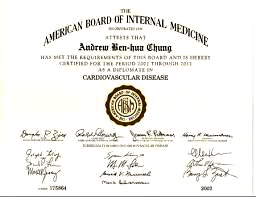
I am not Dr Chung, but I have one just like his—it has my name. Dr Chung’s is on the internet
There are significant differences from specialty to specialty. In general, however, you need a certain personality to enjoy your job as a physician, depending on your chosen branch of medicine.
Surgeons tend to be more flamboyant than internists. They usually like instant gratification. Their motto is “When in doubt, cut it out.” But internists need to enjoy small victories; in fact they have to consciously identify their personality goals, or they could hate their jobs.
It’s all about destinations. If you are an internist and your goal is to prevent death, heart attacks and strokes, then you are seeking success in distant end points which you might not be able to measure. You need to measure something to see if you are a winner or a loser—a good doctor, or not. In hypertension, we can measure the blood pressure. The top number is systolic, while the bottom is diastolic. They are both important.
I have always enjoyed (yes, doctors can enjoy what they do) diagnosing and treating hypertension. In the 1960’s, it was much more of a challenge than it is now because now we have technology (eg echocardiograms), a wide variety of effective medications, and a major public health initiative to deal with the “silent killer.”
In 1941, FDR had a blood pressure of 188/105. We would have called that “moderate hypertension” and it could have been effectively treated with drugs if they had existed. His doctor didn’t have much to do for it. He just took notes in his journal.
In 1944, before FDR went to Yalta, his BP was running 210/120, and then, after that arduous 14,000 mile round trip journey, he developed “malignant” hypertension with heart and kidney failure. He returned to Georgia and had a brain hemorrhage, at which time his BP was recorded at 300/190. He died at age 63. But now, a patient with hypertension can be treated better than the President of the United States over 60 years ago.
When I was an intern in 1966 at Mt . Sinai Hospital in New York, we did the best we could for hypertension with only a few suboptimal drugs at our disposal. It was frustrating. We used a drug called Ismelin (guanethidine). It was pretty powerful, but it had issues, one of which impressed this 25 year old new doctor—it was called retrograde ejaculation. Just the name alone was enough to give any guy the willies. We’ll skip the graphic details. As it turned out, that side effect wasn’t so bad, but it sure was startling. It taught me to ask the right questions about medication side effects.
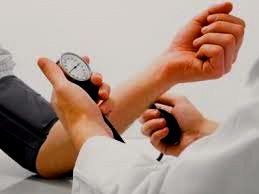
So fast forward to current times where we have so many great drugs for hypertension. We can pretty much get anybody’s BP down to where it belongs, and I loved monitoring that process using a simple device–a sphygmomanometer. You know it as a blood pressure machine. And watching those numbers get to the right place by doing that medication voodoo that we do so well; I found that deeply satisfying. The victories came in small increments, and patience was required.
Part of that pleasure was in knowing about the evidence that showed that treating hypertension can prevent heart attacks and strokes. That provided another ingredient—motivation to do a good job. It’s that EBM—evidence based medicine—that we have been hearing about during our Obamacare discussions.

Which brings me to yesterday’s announcement by an expert panel from the National Institutes of Health regarding the latest guidelines (version #8 since the 1970’s) for the treatment of hypertension. Below is the NY Times article on this subject. It is very good. We will discuss the new guidelines next in Part II.
According to the new guidelines you are OK. I will present the new guidelines in part II, but the therapeutic targets have actually been relaxed some.
Now I am confused. My young 30 ish Doctor says my BP should be 115 over 75. I always thought 120 over 80 was aim point. I admittedly am on average low 140’s over high 80’s. I am 56. Based on this new info I am ok ? I am confused.